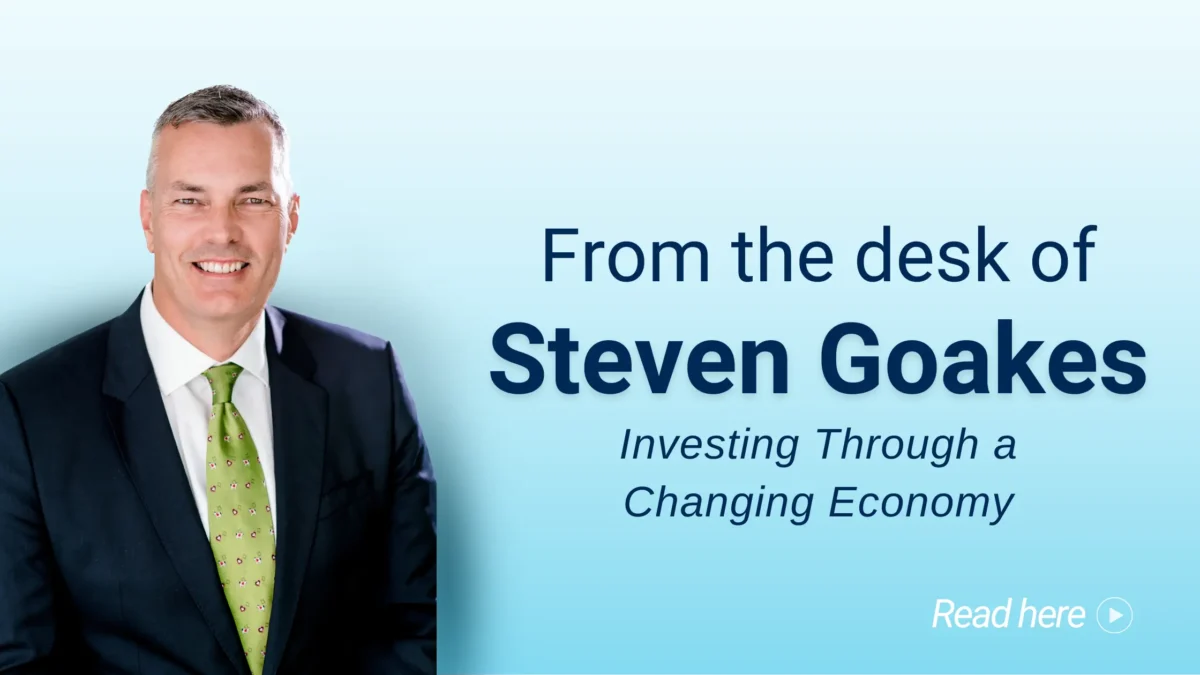
It is my habit each quarter to reflect on the prevailing conditions and Natgen’s responses to the opportunities and challenges of the period. As we close out the third quarter of 2026, there is no shortage of things to consider.
As everyone is no doubt aware, there has been a noticeable change in the economic conversation in Australia over recent months.
House prices are moderating in most major markets, interest rates have risen again, consumer confidence remains subdued and there are increasing signs that economic growth is slowing. At the same time, inflation remains stubbornly above targets, leaving the Reserve Bank with a difficult balancing act.
It is understandable that this combination creates uncertainty for investors, especially when the media takes delight in the use of language deliberately designed to catastrophise the figures.
But uncertainty does not necessarily mean that investment should stop. In many respects, it highlights the value of selectivity, discipline and perspective when investing at any time during the economic cycle.
At Natgen, we spend considerable time monitoring economic indicators, capital markets, government policy and the property markets in which we invest. We don’t do this because we believe we can predict every movement in the economy. We do it because understanding how conditions are changing helps us determine how we should respond – for the benefit of our investors.
There is now reasonable evidence that economic momentum is moderating.
Knight Frank’s October Leading Indicators report records annual real GDP growth of 2.1% to the June quarter, but forecasts growth slowing to around 1.5% by the end of 2026. Unemployment has risen from 4.3% a year earlier to 4.6% in August and is forecast to reach 4.7% by year end.
Business indicators tell a similar story. Australia’s Composite PMI (Purchasing Managers’ Index) remains marginally in expansionary territory at 50.8, but is down from 52.4 a year earlier. Business conditions and confidence are soft and forward orders remain subdued.
Consumers are cautious too. Household spending was flat in August compared with the previous month and consumer confidence remains well below its longer-term average.
Whilst this combination would normally lead us to expect interest-rate relief, right now inflation is a complicating factor. Headline inflation was still 3.9% in August and trimmed-mean inflation 3.6%, while the cash rate has risen to 4.6%.
We therefore have an unusual environment: parts of the economy are slowing, households are feeling pressure and asset prices are responding, but inflation remains sufficiently persistent to prevent the Reserve Bank from providing the relief that borrowers would ordinarily expect.
That tension is likely to remain an important feature of the investment environment for some time.
House prices have been the canary in the coalmine for a slowing economy. The federal government’s dangerous experiment with housing demand and supply through surprise taxation changes has both caused pain and exacerbated the impacts of external cost pressures. Policy on-the-run to minimise unintended consequences has further damaged confidence.
Cotality (RP Data) has reported that Australian housing values fell another 1.1% in September, marking the sixth consecutive monthly decline. National dwelling values are now 5.2% below their March 2026 peak, while an extraordinary 97% of capital-city suburbs recorded falling values over the September quarter. Brisbane, after several years of exceptional growth, recorded the largest capital-city fall in September at 1.5%. Sydney fell 1.4%. Sydney values are now 8.6% below their recent peak and Melbourne 7.2%.
CBA analysis points in much the same direction. It expects a national peak-to-trough residential decline of approximately 9%, with Brisbane around 8%, Sydney 13% and Melbourne 12%.
But the ‘peak to trough’ figures need to be read in context. Coality’s September reporting also concluded that national house prices over a 12 month period had experienced 0% gain or loss. So whilst ‘peak to trough’ numbers provide the most sensational headlines, the ‘over time’ numbers tell a less extreme story. (The national housing peak was in March 2026, just prior to the budget.) So correction is underway, but the sky is not falling in.
There is therefore no benefit in pretending that residential property is merely experiencing a temporary wobble. It is going through a genuine correction, as it has on three other occasions during the past decade.
But there is an equally important distinction to make.
A house in Brisbane, a self-storage facility, an industrial estate and a neighbourhood shopping centre might all be described as property, but the economic drivers behind their values are vastly different.
Residential values are particularly sensitive to household borrowing capacity, mortgage rates, affordability and consumer sentiment. Commercial property is principally an income-producing investment. Its value is influenced by the quality and durability of that income, tenant demand, lease structures, replacement costs, financing conditions and the return investors accept for deploying their capital.
This distinction is particularly relevant in the current environment.
The Federal Government’s changes to negative gearing have understandably generated considerable uncertainty. However, the changes commencing from 1 July 2027 are specifically directed at residential investment property, generally limiting negative gearing to new residential properties while grandfathering existing investments acquired before the Government’s announcement.
Importantly for our investors, commercial property is not subject to the budget changes and remains open to the existing negative-gearing arrangements.
That does not mean commercial property is unaffected by every taxation change – the Government’s broader capital gains tax reforms, for example, need to be considered separately. But it is a useful reminder that headlines about “property taxation” do not necessarily apply equally across property sectors.
There is another element of the current environment that receives less attention – investment capital still needs to be deployed.
Superannuation contributions continue to accumulate. Institutional investors receive new allocations. Family offices and private investors generate cash. Businesses accumulate reserves. Investors continue to receive dividends and distributions. A period of economic uncertainty doesn’t make that capital disappear, so investments must still be made.
Cash may be attractive for a period when interest rates are high, and maintaining liquidity can be entirely sensible. But for most investors, permanently holding cash is not a long-term investment strategy. Capital ultimately needs to find productive assets capable of generating income and preserving or growing its real value.
Commercial property remains one of those alternatives.
The question, therefore, should not be whether today’s economy feels comfortable enough to invest.
A better question is: Which investments provide an appropriate risk/reward ratio?
That is the question we continually ask at Natgen.
In buoyant markets, competition for assets can become intense. Yields compress, buyers become more optimistic in their assumptions and there can be relatively little margin for error.
More difficult markets can produce the opposite effect.
Financing becomes harder. Buyers become more selective. Some owners require liquidity. Development of replacement assets becomes more costly. Vendors become more realistic about pricing. None of that automatically makes an asset attractive. But it can create opportunities for patient investors who have capital available and are prepared to look beyond current sentiment.
There is an interesting additional dynamic today. CBA’s data shows new dwelling construction costs were still increasing at 5.7% annually in July, while rents were increasing at 3.6%.
High construction and financing costs can restrict new supply. In many commercial property sectors, that strengthens the competitive position of existing assets, particularly where underlying occupier demand remains sound.
Again, the important point is to look beyond the broad headline and understand the economics of the individual asset.
One of the most interesting examples in the most recent material available comes from CBA’s interest-rate forecasts, where CBA changed its own RBA forecast twice in four weeks – moving from expecting rates to remain at 4.35%, to forecasting a November increase to 4.60%, and then bringing that increase forward as the inflation data changed.
I think there is an important lesson in that – some of Australia’s most experienced economists, supported by enormous amounts of data and sophisticated modelling, continually change their forecasts as new information emerges.
At Natgen, our approach is similar. We observe, interpret and respond.
We watch inflation, interest rates, employment, consumer activity, business conditions, property yields, transaction volumes, construction costs, credit markets and government policy. We consider what those indicators might mean for our existing investments and for opportunities we are considering.
We then concentrate on the things we can control.
Interest rates are a good example. On $10 million of interest-only debt, a 25-basis-point movement in rates represents approximately $25,000 a year in additional interest expense. A one percentage point movement represents $100,000.
We cannot control the money market, but we can control leverage. We can consider hedging. We can stress-test cash flows. We can negotiate financing and align debt structures with lease profiles and anticipated investment periods. We have a history of doing so.
Similarly:
- We cannot control economic growth, but we can be disciplined about the price we pay for an asset.
- We cannot control inflation, but we can look closely at lease structures and rental growth.
- We cannot control construction costs, but we can consider what those costs mean for future supply and replacement values; and
we cannot control market sentiment – but sometimes market sentiment creates opportunity.
There is little doubt that Australia’s economic environment has become more challenging.
The housing correction is unfolding. Higher interest rates are having an impact. Consumers and businesses are cautious and economic growth appears likely to slow further.
We take all of those factors seriously. However, none of this is unprecedented and for every headline declaring that some measurement is ‘the worst ever’ or ‘the worst in the past X years’, there are measures to indicate that we are simply experiencing the cyclical behaviour that economies have displayed over time, again and again.
Economic cycles are unavoidable. Asset prices rise and fall, interest rates change, governments change policy and investor confidence expands and contracts. The objective is not to somehow avoid these cycles. It is to navigate them intelligently. They do not lead us to the conclusion that investors should simply stop investing.
So for Natgen, that means remaining selective, maintaining sensible leverage, focusing on sustainable income and targeting an appropriate return for the risks we accept on behalf of our investors.
It also means recognising that periods of uncertainty can create opportunities that are much harder to find when markets are universally optimistic.
There remains a substantial pool of investment capital that needs to be deployed. Commercial property remains an important destination for part of that capital. And quality assets with sustainable income do not cease to be quality assets simply because the economic headlines have become less comfortable.
At Natgen, we will continue to monitor the indicators closely, challenge our assumptions and adjust our approach as circumstances change because interpreting change and responding appropriately to it is an important part of the responsibility our investors entrust to us.
Sincerely,
Steven Goakes
Executive Chairman
Natgen provides clients with well-considered, carefully measured commercial investment opportunities, accompanied by professional advice from our experienced leaders.
If you’d like to be notified of future investment opportunities, request an Investor Information Pack or contact us directly at invest@natgen.com.au